
Sources for Maricopa Previous Residents
Address history changes with the era. Current Pinal County systems can seed an inquiry with a parcel, owner, sale lead, and legal land description. The web deed index then supports a backward chain for recent decades. Earlier years require office books, regional publications, census records, newspapers, and archives. This coverage table sets honest limits before the search begins.
| Source | Years it covers | Where held | What it can show |
|---|---|---|---|
| Assessor and GIS parcel record | Current; historical start not posted | Pinal County Assessor | Owner, APN, site and postal addresses, legal facts, year built, and sale lead |
| Recorded Document Search | May 23, 1980 to present online | Pinal County Recorder | Grantors, grantees, deed dates, Fee Number, legal description, and images |
| Recorder books and microfilm | Before the web cutoff; earliest book not posted | Recorder office in Florence | Older transfers and land references |
| City permits | Varies; start not posted | City of Maricopa through JustFOIA | Project dates, applicants, contractors, inspections, and work description |
| Regional directories and phone books | Exact Maricopa runs unconfirmed | Library, archives, museum, or interlibrary loan | Time-stamped name and address evidence when a volume includes Maricopa |
| Federal census | Public through 1950 | NARA and library genealogy databases | Households, relationships, ages, birthplace, and occupation for the census date |
| Pinal birth and death registers | Births 1887 to 1910; deaths 1887 to 1908 | Arizona Archives originals and FamilySearch film | Historic event evidence under archive access rules |
| Arizona newspapers | Overall project coverage 1859 to 1989; title-specific | Arizona Newspaper Project | Obituaries, marriages, land notices, school news, and civic mentions |
Start with the row that overlaps the target year. Do not promise a local reverse-directory volume until a repository confirms its title, date, and Maricopa coverage.
Seed a Maricopa Address Trail
Enter today's address in the Pinal County Assessor Parcel Search. Record the standardized site address, assessed owner, APN, subdivision, and legal description. Then inspect the same parcel in the county GIS viewer. Its popup may add first and second owner names, postal address, year built, sale date and price, and a Reception Number that can help locate a transfer.
Site and postal addresses answer different questions. Site Address locates the land. Postal Address is where the owner receives tax correspondence. A match may support owner occupancy, but it does not prove it. A mismatch may reflect an owner who receives mail elsewhere. Neither field names all previous residents.
The APN is a tax key in Book-Map-Parcel-Split form. Preserve the legal description too, since parcel combinations and splits can change that modern identifier over time.
Walk Pinal Deeds Backward
A chain of title is the linked series of ownership transfers for the same land. The Pinal Recorded Document Search supplies the online portion. Search spelling variants, distinguish the parties' roles, and match the legal description. The GIS Reception Number is only a lead; the recorded instrument controls.
- Find the current assessed owner and legal land description from the address.
- Search the owner in the Recorder index and identify the acquisition deed for that exact parcel.
- Record the seller, called the grantor, and buyer, called the grantee, plus the Fee Number and recording date.
- Search the seller as an earlier buyer. Match the same land, not just the same surname.
- Repeat until May 23, 1980, then continue with Recorder books or microfilm at the Florence office.
- Grantor
- The party transferring an interest in the recorded instrument.
- Grantee
- The party receiving the interest.
- Chain of title
- The sequence of linked transfers for the same land.
- Legal description
- The lot, block, subdivision, or surveyed-land wording that identifies the parcel beyond its street label.
Public web images are unofficial and watermarked. The Recorder accepts copy requests by email, mail, and counter. Copies cost $1 per page; certification adds $3 per document.
Cross Maricopa's 1980 Record Divide
May 23, 1980 is an access cutoff, not the start of Pinal land records. An instrument from May 22 belongs in the earlier office workflow even if the parcel exists in today's Assessor system. Contact the Recorder in Florence for books, microfilm, and copy options. Ask by known party, approximate date, legal land description, or an older Docket/Page citation.
This exact-day divide is unusually useful. It prevents a false conclusion that an older transfer never occurred. The Recorder makes accepted instruments permanent public records, scans them for access, and microfilms them for archival needs. Online and extant are different conditions.
Note: Maricopa has a local Assessor counter for parcel help, but the Recorder's historical and certified-copy channels remain centered in Florence.
Date Maricopa Address Records
A deed dates a transfer, not the structure. For post-incorporation work, request existing applications, permits, inspection history, certificates of occupancy, and plans from the City of Maricopa through JustFOIA. Give the standardized address, APN, record class, and a bounded date range. A permit can identify an applicant or contractor and describe work, but neither role establishes who lived there.
Maricopa incorporated in 2003. Earlier planning and development evidence is more likely to sit in county or regional files, especially when the parcel was outside city limits. Current postal wording does not settle past jurisdiction. Check the city's addressing result and annexation timing before choosing the custodian.
Permits help separate the age of the land transfer from the date of the assessed structure or a later remodel. They also explain gaps when an old rural tract became a platted subdivision with a new street address.
Find Past Maricopa Households
Owners are only part of the previous-residents trail. A regional directory, telephone book, census schedule, newspaper, oral history, or school record can name someone associated with the place for a specific year. No authoritative long stand-alone residential or reverse-directory run for Maricopa was verified. A FamilySearch catalog lead for a Polk Casa Grande and Pinal County directory may help, but its editions and Maricopa inclusion must be confirmed before use.
Pair household sources rather than stretching one record across decades:
- Choose the target year and preserve the address form used at that time.
- Check a confirmed regional directory or telephone volume for that year or the nearest available edition.
- Match a public federal census year through 1950, noting the enumeration district, page, line, and household.
- Search newspapers by surname, Pinal County, town variant, school, ranch, railroad, or civic group.
- Bridge the named person back to the parcel with a deed, probate file, marriage record, or other dated public source.
The exact collections and their limits belong with the Maricopa city directory collections. An edition proves an entry for its publication year, not a continuous stay. For material that is not online, ask the Maricopa Library reference desk at 520-568-2926 about catalog searches and interlibrary loan. The Maricopa Historical Society holds photographs, oral histories, and written histories but advertises no public name index. The Arizona State Archives genealogy collection is the next fallback for historic court, probate, newspaper, vital, and state material.
Search Older Maricopa Address Names
Maricopa's trail crosses Maricopa Wells, the 1879 Maricopaville railroad stop, and the present rail site established in 1887. Older catalogs, news, census records, and correspondence may use Maricopa Junction, a rural route, a ranch, a railroad marker, or a section-township-range description instead of today's street. Before Pinal County was organized on February 1, 1875, territorial material may sit under predecessor Maricopa or Pima County records.
Another shift occurred in 2009, when USPS changed 85238 and 85239 to 85138 and 85139 without moving the streets. Search both ZIP forms around the change. A catalog result labeled Maricopa County usually points to the Phoenix-area county, not this City of Maricopa in Pinal County.
The story matters because the place moved before it produced a modern municipal paper trail. Search vocabulary must follow the address era.
Close Maricopa Previous Residents Gaps
When a person leaves the deed or directory trail, newspapers and probate may provide the next dated link. The Arizona Newspaper Project supports searches for obituaries, marriages, school news, land notices, and civic events. Include Casa Grande and Florence regional titles, since a Maricopa event may have been reported outside the city.
The Arizona Newspaper Project search screen is a direct route into those title and date searches.
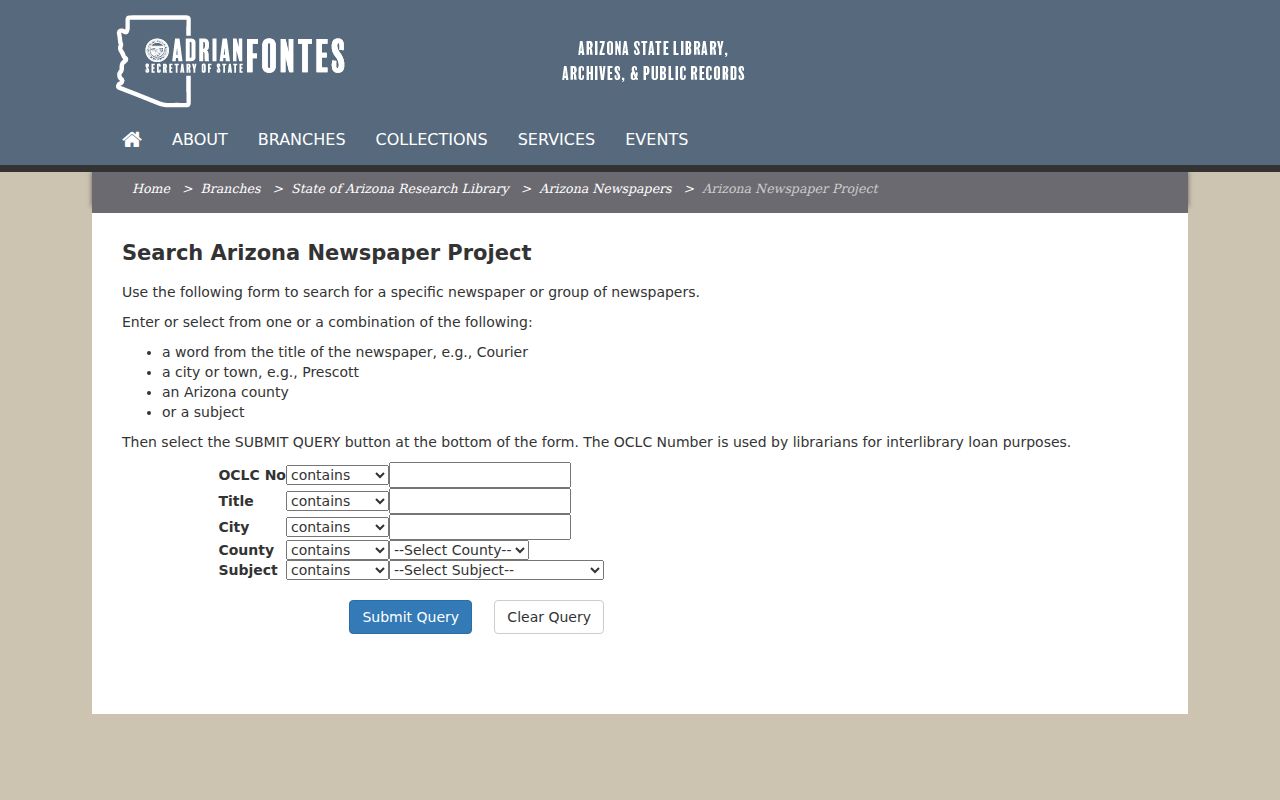
A newspaper match becomes stronger when its date, relatives, school, ranch, or property reference agrees with a deed, census row, or probate case.
Pinal Superior Court probate files may identify a decedent, personal representative, devisees, heirs, notices, and property when those filings are public. Use the statewide court index as a locator, then request the actual file from the Clerk of Superior Court. Sealed and protected material stays unavailable.
Use Arizona Genealogy Thresholds
Arizona's official genealogy search opens births after 75 years and deaths after 50 years under A.R.S. § 36-351 and archive procedures. That historical route differs from eligibility-controlled access to modern certified certificates. Pinal's surviving historical birth registers cover 1887 through 1910, while death registers cover 1887 through 1908 in the cited archive catalog.
The Arizona genealogy birth and death search is the official starting point for records that have crossed the public threshold.
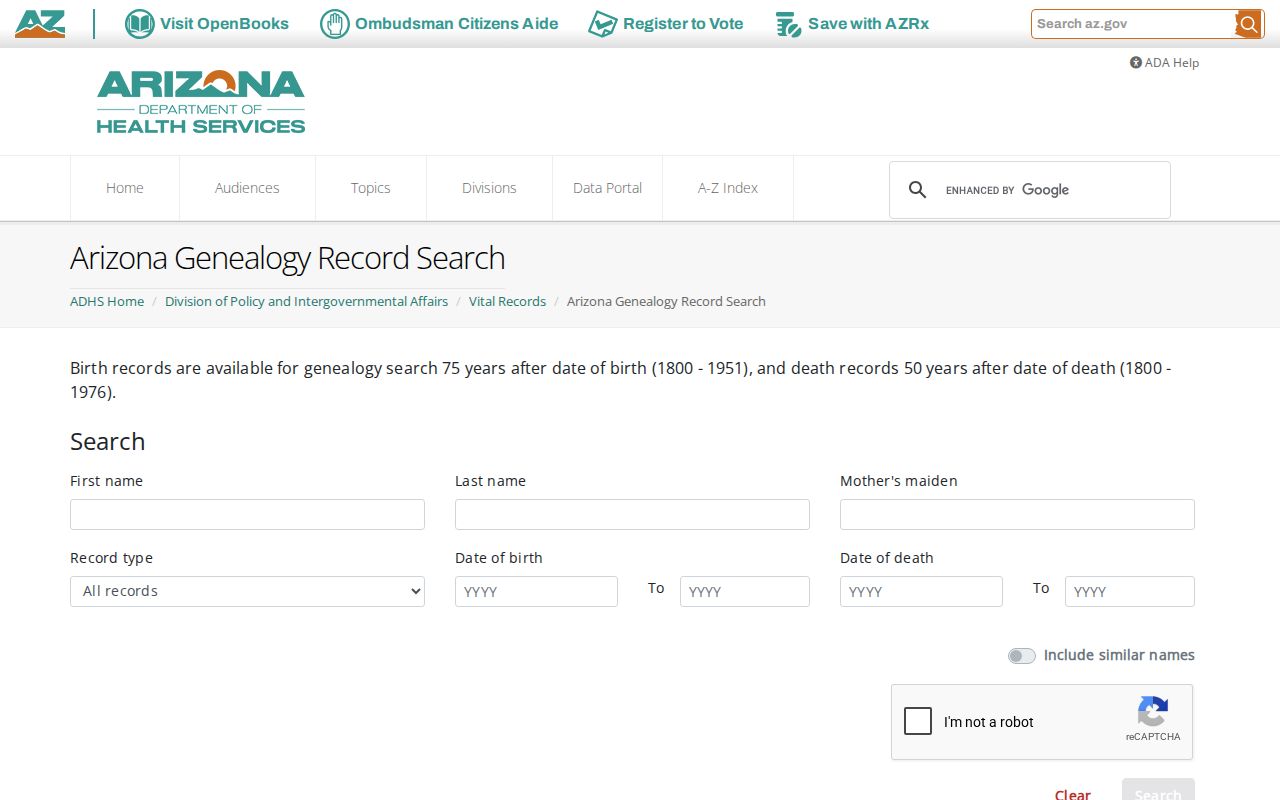
A historical event record can confirm identity or family links, but it does not by itself establish residence at the parcel under study.
Limits on Maricopa Past Residents
No source should be made to say more than it does. Deeds establish an interest in land. Assessor fields establish an assessed owner and tax-mail route. Permits document work. Census and directory entries are snapshots. Obituaries can contain family-supplied facts, and oral histories preserve memory that should be checked against dated records. A private occupant may leave no public address-indexed trace.
Preserve source dates, name variants, APNs, legal descriptions, deed Fee Numbers, census citations, newspaper title and page, and probate case numbers. If two people with the same name remain plausible, leave the attribution unresolved. An absent result can reflect a coverage gap, old place label, protected record, or wrong custodian.
Lawful use. Research Maricopa past residents for family, property, heir, or community history. Never use an address trail to stalk, harass, threaten, or expose a living person.